
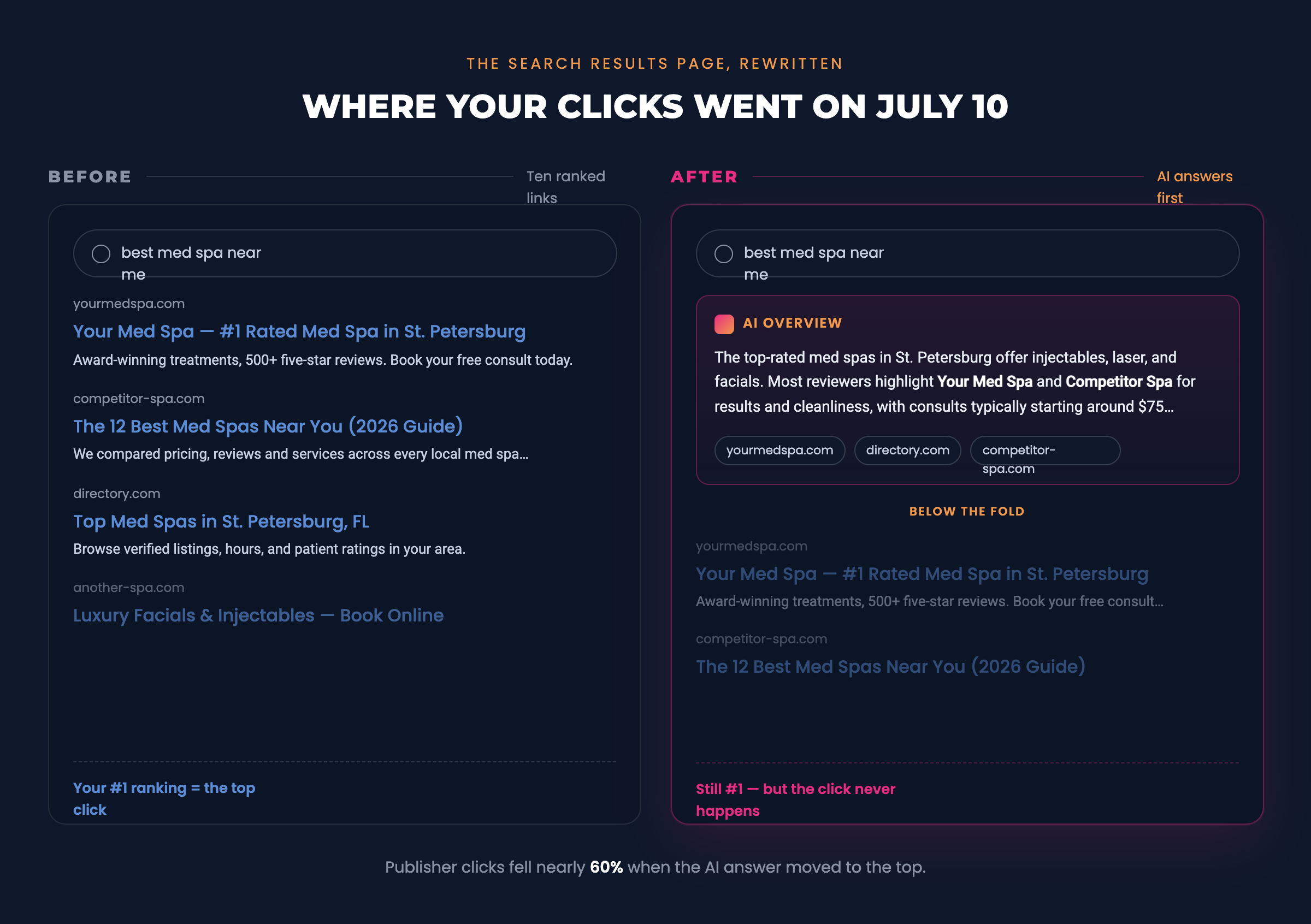
On July 10, 2026, Google quietly finished the biggest change to its search engine in more than 25 years. An AI-written answer is now the default result for every search. It's the first thing people see, every time. You ask, Google answers in full sentences, and the familiar ten blue links now sit below the fold, if they show up at all. Early reporting puts the drop in clicks to websites at nearly 60%. If your business depends on people finding you through Google, that number should get your attention.
What actually changed
For a quarter century, Google's job was to hand you a ranked list of pages and let you pick one. Now its job is to read those pages for you and write the answer itself. When it does, it cites a handful of sources right inside the answer, like footnotes in an essay. The links are still there. They've just been demoted. The AI answer comes first, and most people never scroll past it.
For a business, that changes the goal. Page one used to be the prize. Now the prize is being one of the sources Google's AI trusts enough to quote. That's a different skill, and it's much harder to fake.
Why ranking #1 no longer guarantees clicks
Here's the sneaky part. Your rankings can look fine while your traffic slowly drains away. There are now two different problems, and they look very different in your data:
- A ranking loss shows up as falling position and falling impressions in Search Console. Google decided your page deserves to be lower.
- An AI-answer squeeze shows up as stable position but falling clicks and click-through rate. You still rank #1. Google just answered the question itself, so nobody clicked.
The fixes are opposite. A ranking loss means your content quality or authority slipped. A squeeze means Google is handing out the answer and someone else gets the credit. The fix is to become the source the AI names. That's the heart of answer engine optimization. If you're not separating these two in your own analytics, you're guessing.
The rulebook changed twice more this summer
The July 10 switch didn't happen in isolation. Two other moves make the direction unmistakable. First, Google confirmed that smaller ranking updates now roll out continuously, without announcement. So waiting for a quarterly "core update" before you fix your site is off the table. Second, Google updated its spam policies to state, for the first time, that trying to manipulate its AI answers is against the rules. In plain English: you earn citations. Try to game them and you get demoted.
What actually earns a citation now
The pages that get quoted across Google's AI answer, ChatGPT, Perplexity, and Gemini tend to have a few things in common. They're built so machines can read them easily:
- Answer-first structure: the direct answer stated cleanly up top, so a model can lift it as a clean, attributable claim.
- Cited evidence: real numbers, sources, and specifics an AI can stand behind.
- Concentrated authority: one deep, expert page on a topic beats ten thin ones.
- Verifiable expertise: content tied to real people with a real business track record.
Since July, Google Search Central has said appearing in AI Overviews and AI Mode is still regular SEO. No extra file or special schema needed. Read the update: Google Says AEO Isn’t a Separate Game. How we run that work is how we work.
Where your Brand Vault comes in
We build the file Google and AI keep on your business. That's the Brand Vault: an organized record of the facts, proof, and expertise about your company, written so answer engines can read it, trust it, and quote it. You have the final say. As search sends fewer clicks and more answers, AI reaches first for businesses whose information is clean and organized.
So, don't panic. The old scoreboard (a stack of rankings) now measures only part of the game. Becoming the trusted source takes time to build, so my advice is to start now. Do it well and you'll rank, and you'll be the answer too.
Keep reading
Google Says AEO Isn’t a Separate Game. Here’s What Still Is
Is your business ready to be the answer?
Take our 60-second assessment for an honest read on whether SEO & AEO is right for you right now. Or book a call, and we'll check how visible you are in AI-first search.